
The Orchestration Layer:
Why a 5-Physician Practice Now Has More Strategic Firepower Than a 500-Bed Hospital

Healthcare AI spending tripled to $1.4 billion in 2025. Almost all of it went to hospital systems.
The independent physician playbook for building asymmetric advantage starts here.
There is a word for what happens when a small team with the right technology outperforms a large organization with the wrong bureaucracy.
The military calls it asymmetric warfare.
In healthcare, it is called the orchestration layer. And it changes everything about how independent medicine competes.
IN TODAY’S ARTICLE:
The orchestration layer thesis: how AI transforms independent practices from reactive operators into strategic competitors.
Three tiers of AI adoption. Operations, Intelligence, Strategy. Where to start and what each tier unlocks.
The $38 billion healthcare IT market is being rebuilt around AI. Physicians who do not understand this will be acquired by those who do.
A practical framework for physician-owners who want strategic firepower without hiring a team of analysts.
Glossary at the bottom of today’s article.
THE BILLION-DOLLAR BLUFF
The healthcare establishment wants you to believe that AI is a health system technology. That it requires billion-dollar budgets. Enterprise IT departments. Chief AI Officers with corner offices and PowerPoint decks thicker than a CMS proposed rule.
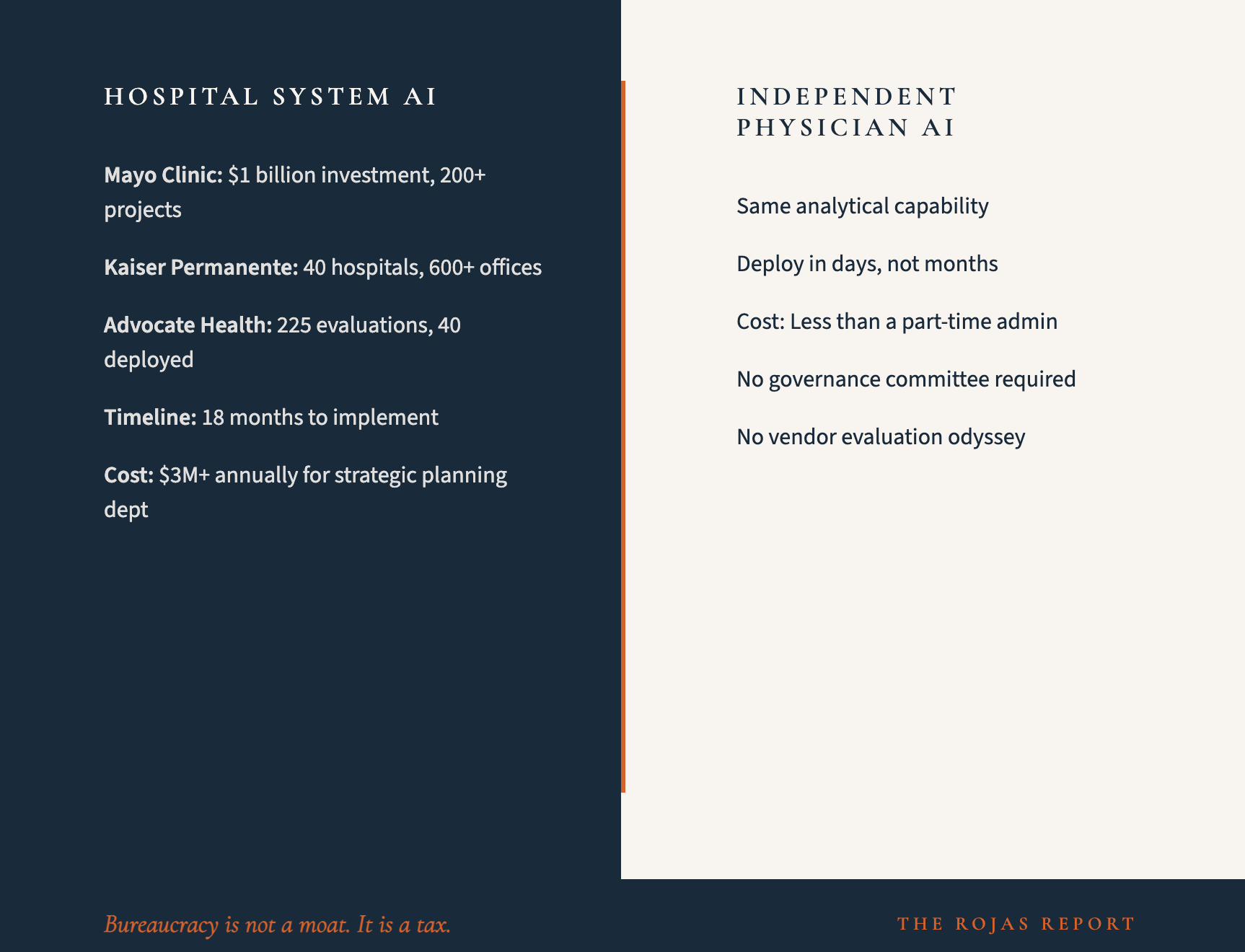
Mayo Clinic is investing $1 billion in AI across 200 projects. Kaiser Permanente deployed ambient AI across 40 hospitals and 600 medical offices. Advocate Health evaluated 225 AI solutions to select 40 to go live with.
The message is clear: AI is for the big boys.
That message is a lie.
Not because those investments are fake. They are real. But because the underlying capability they are purchasing is no longer exclusive to organizations that can write nine-figure checks.
The global healthcare AI market hit $39 billion in 2025. Healthcare AI spending nearly tripled to $1.4 billion last year. Eight healthcare AI unicorns were minted. The money is real.
The analytical capability that used to require a team of analysts working for weeks now runs on tools that cost less per month than your EHR subscription. Health systems are not buying AI because it is complex. They are buying AI because their bureaucracies make everything complicated.
They need 225 evaluations to select 40 solutions because they have compliance committees, IT governance boards, integration teams, and procurement departments that turn every decision into an 18-month odyssey.
You do not have that problem.
You have a different problem.
You do not know what is possible.This article fixes that.
Every day you operate without strategic visibility, you pay a tax you cannot see on an invoice. The health system that wants to acquire you can see it perfectly.
More than 100,000 readers in January decided to stop being the last to know.
Subscribe
